
How to Toilet Train a Puppy: A Calm, Step-by-Step Australian Guide
Every new puppy owner has had this moment. You turn your back for thirty seconds, and there it is: a small puddle spreading across the floorboards, and a puppy looking up at you with absolutely no idea it’s done anything wrong.
If that’s the stage that you are at, you’re in very good company. Toilet training is the first big project of puppy parenthood, and almost everyone finds it slower and messier than they expected. The good news is that it’s also one of the most predictable things to get right. Puppies aren’t intentionally being naughty. They simply haven’t learned yet where the right place to evacuate is, and their tiny bladders can’t hold on for very long. Your job is to make the right choice easy and rewarding, over and over, until it becomes a habit.
This guide walks through realistic timelines, how to set your puppy up to succeed, the step-by-step method, night-times, what to do about accidents (hint: never punishment), and the few times toilet trouble means a trip to the vet.

This guide is general information for Australian dog owners and isn’t a substitute for veterinary advice. If your puppy is straining, going far more often than expected, or there’s blood in their wee, please see your vet — toilet troubles sometimes have a medical cause.
Most puppies are reliably toilet trained somewhere between four and six months of age, but there’s a wide normal range, and “reliably” doesn’t mean “never has an accident.” It is very normal to have setbacks, especially in the first couple of months and during any big change like a house move.
A useful rule of thumb for bladder control: a puppy can usually hold on for roughly one hour per month of age, plus one — so a three-month-old might manage around three to four hours during the day. Overnight is often a little longer. Younger than that, and you’re on very frequent trips outside.
The single biggest predictor of how fast it clicks isn’t the breed or the puppy — it’s how consistent the humans are. Get the routine right and most puppies surprise you.
A puppy can usually hold on for roughly one hour per month of age, plus one.
Toilet training is far more about prevention than correction. Three things do most of the work.
A predictable routine. Puppies’ bodies are wonderfully predictable. They almost always need to go:
- First thing when they wake (morning and after every nap)
- Within about 10–15 minutes after eating or drinking
- After play, training or excitement
- Before settling for the night
Take them to the toilet spot at every one of these moments, plus regularly in between. With a young puppy, “regularly” can mean every hour or two. Yes, it’s a lot of trips. It’s also temporary.
A designated toilet spot. Pick one spot in the yard and take your puppy to the same place each time, on lead if that helps them focus. The smell builds up and becomes a cue that says “this is the place.” If you’re in an apartment, the same logic applies to a balcony pad or a specific patch of artificial turf (more on apartments below).
Supervision and confinement. A puppy who’s roaming the house unwatched is a puppy who will find a quiet corner to wee in. When you can’t actively watch, pop them somewhere smaller and safe. This can be a playpen, a puppy-proofed area, or a crate they’re happy in. Most puppies instinctively avoid soiling their sleeping space, which is what makes a crate such a useful toilet-training tool.
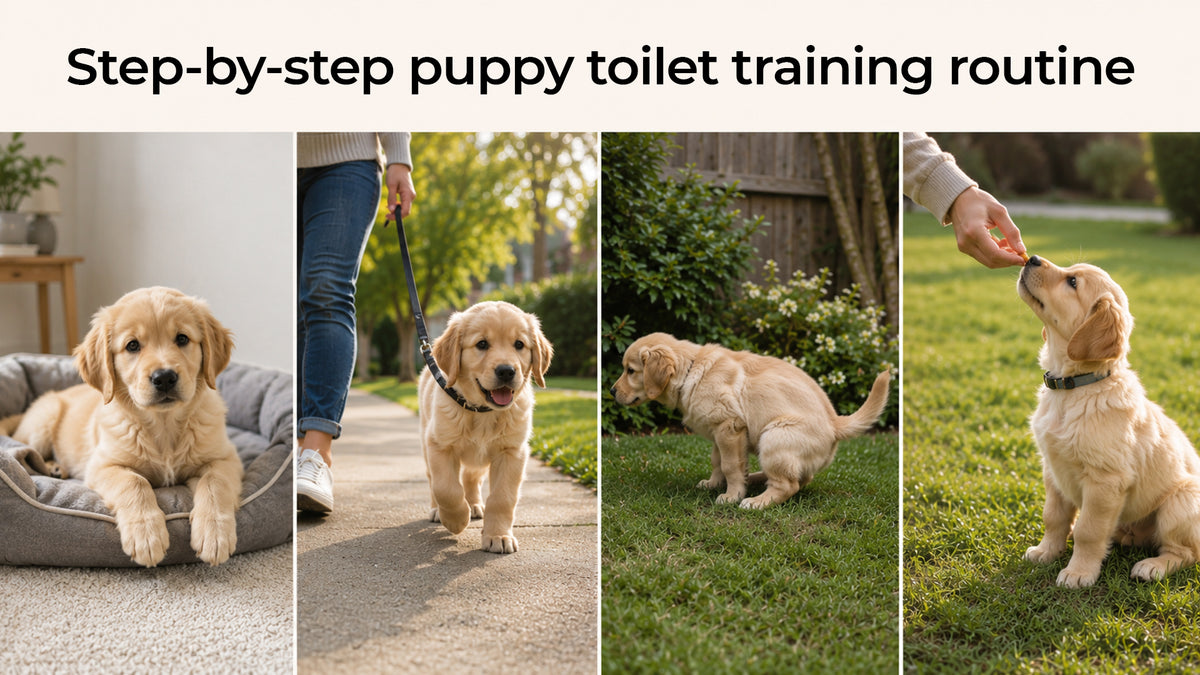
That’s the whole method. It’s not complicated — it’s just relentless for a few weeks. Consistency from everyone in the household is what turns it from a chore into a habit.
Take them out at every likely moment
How to do it
Take them out at every likely moment (the list above), and carry a young puppy to the door so they don’t go on the way.
Go to the same spot
How to do it
Go to the same spot and wait. Give them a few quiet minutes. Boring is good, this isn’t playtime yet.
Add a cue word
How to do it
Add a cue word as they start to go — something simple like “toilet” or “wees.” Say it calmly while they’re in the act, not before. Over time the word itself can prompt them.
Reward immediately
How to do it
Reward immediately — the second they finish, while you’re still outside, with a small treat and warm praise. Timing is everything: a reward thirty seconds later, back inside, teaches them nothing. A training pouch clipped to your belt keeps treats handy.
Then play
How to do it
Letting the fun start only after they’ve gone teaches them that toileting unlocks the good stuff, and stops them holding on just to stay outside longer.
Supervise or confine the moment you’re back in
How to do it
The cycle repeats.
A crate isn’t a cage or a punishment — used kindly, it’s a cosy den your puppy chooses to rest in, and it makes toilet training dramatically easier because puppies naturally try not to soil where they sleep.
The trick is sizing: the crate should be just big enough for your puppy to stand, turn around and lie down comfortably. Too large and they’ll happily wee in one end and sleep in the other. Many crates come with a divider so you can expand the space as your puppy grows. It is a good idea to build positive associations for your pup when they are in their crate. Feed them in there, add a comfortable bed and a familiar-smelling blanket, so the crate feels like a good place, never somewhere they’re sent in trouble. Never use a crate for longer than your puppy can comfortably hold on.
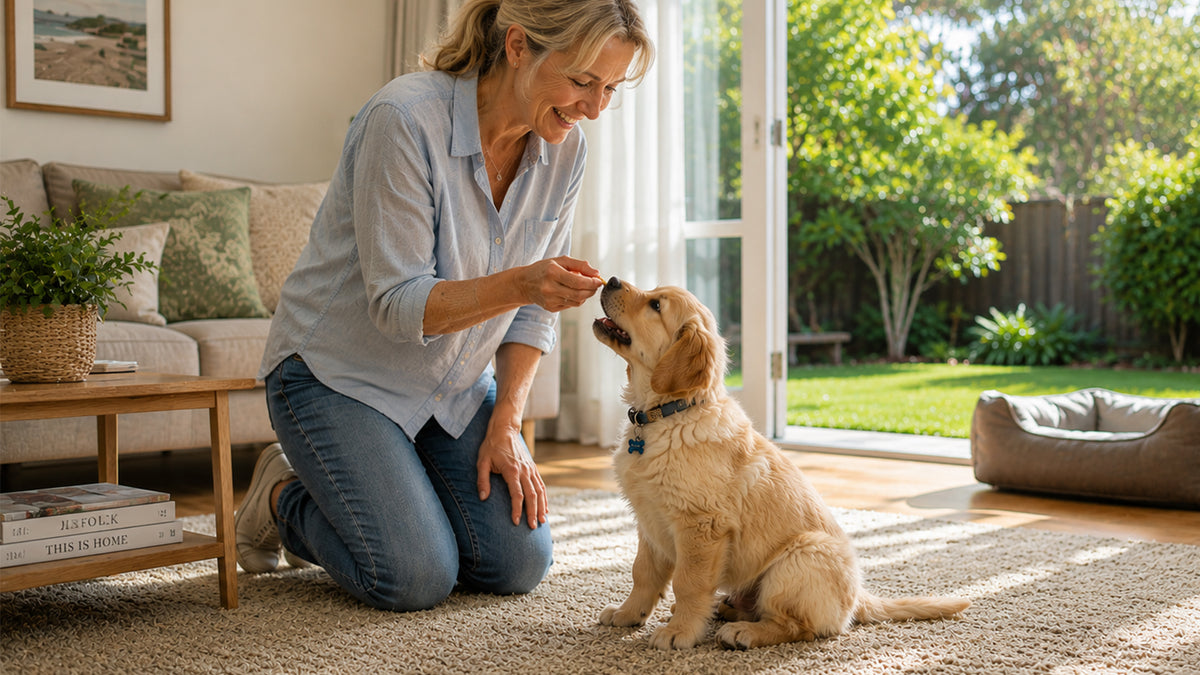
Night-times take a little patience. A young puppy genuinely can’t last the whole night at first, so plan for one or two wake-ups in the early weeks:
- Last toilet trip as late as you can manage before bed
- Keep the night trips calm and boring. Go outside, wee, reward, straight back to bed. Do all this without play and with minimal fuss, so they don’t learn that 2am is party time
- Lift the water bowl a little before bedtime (not so much that they go thirsty — check with your vet if unsure)
- A crate or confined sleep space beside your bed means you’ll hear them stir before it becomes an accident
Most puppies start sleeping through without a toilet break somewhere around 12–16 weeks, as their bladder catches up.
Accidents aren’t failures. They’re feedback that the puppy needed to go out sooner, or wasn’t being watched closely enough. Two rules:
Never punish. Don’t scold, never rub their nose in it, don’t smack. Puppies can’t connect a telling-off to something they did even a minute ago. All it teaches them is that you’re unpredictable and scary, and it often makes things worse by teaching them to hide and wee somewhere private. If you catch them mid-act, a calm interrupting sound and a quick scoop outside to finish (then reward) is all you need.
Clean it properly with an enzymatic cleaner. This matters more than people realise. Ordinary household cleaners — especially anything ammonia-based — leave a scent only the dog can detect, which marks the spot as a toilet and invites a repeat. An enzymatic pet cleaner breaks the odour down completely. Blot, don’t scrub.
If accidents suddenly increase after things were going well, ask yourself what has changed. Has there been a new routine, a growth spurt, or a stressful event. If there’s no obvious reason, consider a vet check.
Plenty of Australian puppies grow up in units, and toilet training still works, you just need an indoor or balcony option alongside (or instead of) the backyard. Designate a specific spot with a pad or a patch of real or artificial grass, take your puppy there on the same schedule, and reward in exactly the same way. If your long-term goal is for them to toilet outside, you can gradually move the pad closer to the door and then outdoors over time. Be patient with the transition — changing the “where” after they’ve learned one spot takes a little re-teaching.
Going inside right after coming in from outside. Usually means they got distracted outside and didn’t fully empty, or the outside trip became about play. Keep the spot boring, wait a little longer, and only reward actual results.
Regression around 4–6 months. Some puppies who seemed nearly trained have a wobble as they hit adolescence. Go back to closer supervision and frequent trips for a week or two. This phase will pass.
Excitement or submissive wees. A little dribble when greeting or when excited is common in young puppies and usually outgrown. Keep greetings calm and low-key rather than making a fuss, and never tell them off for it — it’s not something they can control.
Most toilet-training struggles are about consistency, not health. But see your vet if your puppy:
- Is straining, crying or seeming uncomfortable when toileting
- Is suddenly going far more often, or in much larger amounts
- Has blood in their wee, or wee that smells unusually strong
- Was reliably trained and then regresses with no clear reason
- Is drinking noticeably more than usual
Urinary tract infections and other conditions can masquerade as toilet-training problems, especially when a toilet trained puppy suddenly can’t hold on. A quick vet check rules them out.
Toilet training feels endless while you’re in it, and then one day you realise it’s been a fortnight since the last puddle. Get there with routine, patience, generous rewards and zero punishment, and your puppy will get there too — usually faster than you expect.
You’ve got this. So has your puppy.
Frequently Asked Questions
Most are reliably trained between four and six months, with a wide normal range and the odd accident well beyond that. Consistency from the whole household is the biggest factor.
First thing on waking, after meals and drinks, after play, before bed, and regularly in between — for a young puppy, every hour or two. The rough bladder-control guide is about one hour per month of age, plus one.
Either works. Outdoor-only training is often quicker if you have easy yard access; pads suit apartments or while a puppy isn’t fully vaccinated. You can transition from pads to outside over time.
Usually they got distracted and didn’t finish, or the outdoor trip turned into play. Keep it calm and boring, wait a bit longer, and reward only when they actually go.
No. The same principles — routine, supervision, reward, proper cleaning — work for older dogs too; it can just take a little longer to undo established habits.
Never. Punishment doesn’t teach a puppy where to go and often makes them anxious or sneaky. Reward the right behaviour instead, and clean accidents thoroughly so they’re not drawn back to the spot.


